

Environmental DNA, or eDNA, sampling is a useful technique that Park scientists are using to gain a greater understanding of local fish biodiversity and population dynamics.
 Paired with traditional fish survey methods, eDNA can provide a more comprehensive picture of what fish species are present in the River.
In 2019, HRPK’s River Project launched an eDNA survey with partners at Cold Spring Harbor Laboratory. During this two-year study, HRPK staff scientists collected samples in the Park, filtered them and extracted the DNA from the filters. These samples were then sent to experts at Cold Spring Harbor Lab for DNA isolation, next-generation sequencing and metabarcoding. Check out the results!
Today, the Park continues eDNA research with partners from the New York State Department of Environmental Conservation, Lamont-Doherty Earth Observatory and the Center for the Urban River at Beczak to map the presence of fish species of interest within the Lower Hudson River Estuary.
What is eDNA?
DNA is genetic material possessed by all life, and it carries information about how a living thing will look and function. Aquatic eDNA is genetic material from the sloughed cells, tissues, and excrement of marine organisms.
Within the Park’s Sanctuary waters, we can find DNA from a wide range of wildlife, including oysters, seahorses, and ducks, all in a small sample of River water. By analyzing this genetic material, we can understand more about biodiversity, migration patterns of fish and other wildlife and monitor species of interest, such as endangered or invasive species, that are present within our Estuarine Sanctuary.
Learn how we collect and process eDNA in HRPK


About the Cold Spring Harbor Lab eDNA Fish Study
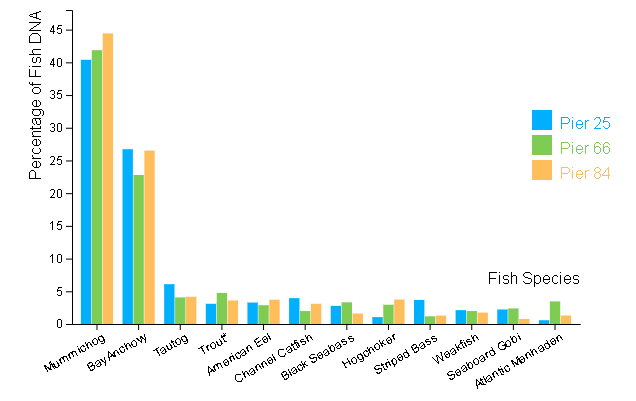
As a baseline study in 2019, Hudson River Park staff, interns and local students collected water samples from Hudson River Park’s Pier 25, Pier 66 and Pier 84 (see the chart below). These samples were taken biweekly throughout the year and filtered to collect DNA. Cold Spring Harbor Laboratory then extracted and amplified the desired barcode region, a section of the 12S ribosomal RNA, using polymerase chain reaction (PCR). After confirming the region was copied, the DNA was sequenced to identify each species that was detected in the samples.
Visit this page or follow the link on the chart below for an interactive map highlighting notable eDNA findings from this baseline study. Stay tuned for new metabarcoding & sequencing data as we continue to analyze additional samples.
Take a Deeper Dive